Sunday, 4 January 2015

My gaming 2014 - not quite as planned

Apparently this sort of post is meant to be written on New Year's Eve - instead I was trying to get a group of savage orcs finished... and in fact didn't manage either. I'm still going to count them against my 2014 tally though!

So, how did I do against my so-called unambitous goals from this time last year? It seems I wasn't unambitious enough!

Collecting

Buying stuff continues to be the easy bit of the hobby, although rather haphazard - partially due to the vagueries of eBay, but also down to inconsistent focus.
It looks from the figures I've bought as though I'm focussing on Empire and hobgoblins, and for hobgoblins that's true - although with several false starts. The Empire figures are just down to a splurge while at Foundry for BOYL 2014, it's just possible they'll become my first "good guy" army, although I'd prefer for that to be dwarves. My firm preference for the old Perry dwarves, and the eBay prices for these, mean that stunties are still a distant dream.

On the RPG front I've picked up a lot of the older books I was after - Death on the Reik and Power Behind the Throne, as well as Moldvay's D&D Basic and Expert rules. The last of these gave me quite a nostalgia trip when it arrived in the post, well worth the relatively modest outlay. On the new-but-old front I signed up to the Bethorm Kickstarter, so now have a toe-hold in that setting as well.

Score: 6/10

This year - more of the same -
  • On the figures front I'm going to let myself dabble a bit - more in my projects post to come. But at a minimum I need to put together a hobgoblin force for this year's BOYL
  • On RPGs it's time to focus on stuff from this decade - in particular The One Ring has caught my fancy.

Painting

My colour mixing has improved somewhat, mostly thanks to help from my wife who knows what she's doing on this front. I'm often not ending up with exactly the colour I was looking for, but at least in the right direction. I'm feel doing better on the planning side of things as well, although by leaning heavily on ideas from others in the community.

In terms of output it's a bit of a failure though - I'm only really at the 1000 point mark of painted orcs, and my avatar's not seen a brush in over a year. I've gone through productive and stagnant periods, although the latter often down to life being too busy rather than lack of motivation. Hopefully this will improve this year.

Score: 5/10

This year -
  • Move to using a wet palette
  • Blending not dry brushing where practical
  • 60+ figures painted, including my forum avatar and some "good guys"

Gaming

A much busier year on the gaming front, but still it didn't seem full enough. I didn't manage a game of 2nd edition, and am still rather mixed up on the rules front, but I did manage both days of BOYL. 

Score: 6/10

This year -
  • Keep up the Oldhammer, while becoming more involved with my local club

Blogging


Not a good year - less than half of my target output, and while I did branch out slightly to looking at the Old World setting from an RPG rather than wargaming point of view, still focused exclusively on the Warhammer world.

Score: 4/10

This year -
  • Try again at last year's plan. Focus on regular and structured blogging, that's not beholden to my painting output

Reading list - 2014

The Dreaming Tree - C.J. Cherryh


I was prompted to re-read this book by its inclusion in the bibliography for GURPS Celtic Myth. It's included there under modern fiction "likely to inspire GMs" and it certainly lives up to that! In fact my reading of it was some slowed by the need to have a notebook at hand at all times.

If I had to sum it into a single word though that would be "atmosphere" - impossible to convey in a short review, especially by a writer such as myself. Suffice to say that Cherryh's sidhe are nothing like Tolkien's elves, and at times the feeling of impending doom makes the book hard to read.

The one flaw is the ending, which left me feeling cheated of the denouement that the books had been building up to. I note from Wikipedia that my copy has a revised ending, which Cherryh felt more satisfying than the original - some day I must find the original and see how I feel about that.

I'm still very glad to have revisited it though - if I ever do get to develop a Norse / Celtic / Sidhe campaign, and it's even 10% as atmospheric as this book, then I'd consider it a resounding success.

The Hydrogen Sonata - Iain M Banks


A good Banks book, but not amongst his best, although that still makes it pretty damn good by most writer's standards.

It's an enjoyable tale, with some surprising twists, but at times the plot armour shows through somewhat. And in places the Culture characters are so smug that you find yourself hoping they'll lose, but I don't think I'm giving too much a way by revealing that they don't... 

It also suffers slightly from uneven pacing - it seems to me a hundred pages or so could have been edited from its length without the story suffering.

I tend to take gaming lessons away from most non-work-related books I read and this is no exception. Firstly it reminds me why I steer clear of sci-fi in RPGs - the breadth of imagination required on even the mundane areas of world-building is a very high hurdle, and authors like Banks put most other works to shame on this score. And equally on the wargaming front, as this story shows it's hard to give much credence to any two space faring races to being close enough in technical level that a straight table top battle could occur - asymmetric warfare seems the only plausible type to me. Even for example in the 40K universe, which has a good backstory as to why the Imperium is a non-technical space faring civilisation, it's a bit hard to swallow that any two factions are effectively equal on the battlefield (I know, I know, stop over-thinking and enjoy the game!).

The Explorer - James Smythe


Another incursion into my reading list from my wife's book group, and a story only one of the group members enjoyed. I did as well - the plot twist right at the beginning almost makes the book worthwhile by itself, but from there it gets even better, although the claustrophobic atmosphere makes for difficult reading at times. Another down side is that none of the characters are sympathetic, which makes it a hard book to enjoy.

Good exercise for the brain though, once all is revealed you're left with the feeling you should go back and read it all again, to see it all in yet another light.

Apparently there's a sequel - hopefully I'll get to that this year.

The Forest House - Marion Zimmer Bradley

Another book from my Celtic reading list, although perhaps less distinctly so. Like Kay's Sarantium, it's a nice touch that it crosses the line from historical / romantic to fantastic in that the druids and priestesses mix learning (e.g. medicine) with actual magic.

Bradley conveys the period with some clever devices such as focussing on a few mundane features of the setting, such as the furnishings. It's interesting to me to contrast this with Tremayne's Seventh Trumpet - Bradley with (I assume) far less scholarship, but more talent, succeeds much better in portraying a distinctive view of the time.

From a story rather than atmosphere point of view the book has a few grating moments - the central relationship between Eilan and Gaius rings rather false at times, with their inner voices seeming rather forced into conveying a romance which somehow isn't supported by the rest of the story.

I'll come back to finish the series at some point, but it's not top of my list.

Rivers of London - Ben Aaronovitch

Another from my wife's book club, and my favourite read of the year. A very British take on the supernaturalist genre which seems to be in vogue at the moment.

Peter Grant, a rookie bobby, sees a ghost while on guard at a murder scene, which abruptly changes his career path. The book mixes police procedural with mystery and elements of horror, its tongue slightly in its cheek but avoiding decending into farce.

The plot makes use of a central deception, of the sort I know intellectually as a reader of a mystery that I should be looking for, but which I unfailingly fall for. When the deception is revealed at the end you're forced to give a wry smile while mentally revising the entire story, but at the same time this always feels like a bit of a cheat to me, since as the reader you're so dependent on the author for information. The same devise could easily be transposed to an RPG scenario - on the one hand the players do have the advantage that they can ask the GM questions, conversely (assuming no railroads) the GM doesn't have the author's assurance that they'll be able to dangle all the right clues in front of their audience. Not a new conundrum since someone was good enough to invent Call of Cthulhu - in fact I remember John over at Dreams in the Lich House having an interesting series on the subject...

Elric of Melnibone, The Sailor on the Seas of Fate - Michael Moorcock

A flurry of interest in the Stormbringer RPG on G+ prompted me to dig out the novels I have, and fill the gaps in my collection. Back in the day I read through the Corum books, but could never really get on with Elric.

Second time around I'm finding them much more readable, overshadowed slightly by the dimly remembered precis from the RPG - it's not going to turn out alright in the end... But they're good, short, enjoyable yarns, and a good antidote to Conan (as apparently their author intended).

Obligatory RPG observations -
  • Sketching out Melnibonean society as an author is a great feat of imagination, but in many ways far simpler for the author than the GM to convey. What sort of dishes are there at the banquet anyway (for example)?
  • Elric is burning through his ancestors' ancient pacts with various elemental lords at a prodigious rate...
  • Definitely not an "everyman" novel - everyone's a named warrior, a prince, dragon lord or duke (although the same accusation could be levelled at Lord of the Rings, for example). I'm not getting much feeling of the world as seen by mere mortals - although enough to know I wouldn't want to live there!

Thursday, 1 January 2015

A smidgen of savages

My hobby time rather plunged off a cliff in the last four months of the year, with the result that of my target of 50 or so miniatures to paint since early September I've managed only a handful of savage orcs and a shaman.

A handful of savage orcs

I tried to keep their colour scheme to pale clothing (where worn at all) and light wood colours. Along with the blue war paint I'm hoping that they'll stand out from the drabber normal orcs on the table, without themselves being garish.


I'd ideally add some more war paint at some point (I rather like what Thantsants did with his), and devices for their shields, and also give them a matt varnish to knock back the gloss finish that their skin has ended up with. For now though I need to consider them table-ready and move on to other things.

I also want to considerably add to their numbers - while a small group has some tactical value as a slayer-type unit, really I'd like to be fielding a tribal contingent of probably 40+ of them. Not any time soon though!


Mostly still not painted

Tuesday, 25 November 2014

Boars and dragons

Real life scuppered last Friday's plans for what looks like a fine scenario from Gaj over at Warhammer for Adults, pitching my chaos lord against a dastardly witch hunter, so instead I found myself playing Dux Britanniarum.


I was very impressed by the battle rules, both as a set of wargames rules and as an evocation of the period. The campaign rules are apparently even more impressive.

The pre-battle praying, fighting and boasting really helped add to the flavour, and I would think only really work within the dark ages setting. Most of the rules it would seem though could happily be warped into a more standard fantasy setup, which I'm definitely keen to try out for my Newhammer project (although it definitely falls down on my 4th rule for that, more on that later).

Some of the systems, such as the activation process and the random element to movement are probably old hat to people who haven't been out of the wargaming loop quite as long as me, but I quite enjoyed working within the constraints they imposed. The lesser control than I'm used to also seemed to add a slightly more relaxed air to the proceedings (although that might be down to a good opponent and GM). The system for shock (impacting both morale and fighting power) also seemed both a good idea and well implemented.

The real heart of the game though is the Fate card system, whereby throughout the game you can buy random cards, which may be more or less useful for a particular side (or even in some cases completely useless) and can then be spent to boost a unit during its turn, or help counter an opponent's move. They give a nice hidden element to the contest, vaguely reminiscent of the role of magic in Warhammer, and also I felt added a hint of the mythic over the mundane. However they also impose a real limitation on the flexibility of the game (or conversely creates the ability to produce supplements) in that each new army needs their own card set. While I'm sure you could invent your own, in much the same way as you could invent your own codex for modern WH40K, this would always be unsatisfactory and subject to debate.

So while I would heartily recommend the game for some dark ages skirmishing, I'm also disappointed that it's inherently limited in what it does. Although I do have some plans for some dabbling...

Wednesday, 19 November 2014

A late (half) orc

Early orctober was looking quite productive, then suddenly it's late November and I've only just got around to finishing this guy -


Shaman with Skull Staff - classic Grenadier sculpt available from Forlorn Hope Games (amongst others).
Once I finally got my brushes in hand again he was a pleasure to paint, and I'm really pleased with the way he turned out. I'm trying to minimise my drybrushing (although I still used it here on the fur, staff and hair) and instead shade by hand and mostly I think this has turned out quite well. As always the camera highlights some issues which don't really show up in the flesh, but I'm resisting the urge to go back and fix them until I've got a few more chaps painted.

It's savage orcs next, although I'm not sure if I can get mine looking as good as Thantsants' tribe. After that I'll probably find myself painting another shaman - I have a really bad track record for keeping wizards alive in battle, and the trouble with narrative gaming is you can't just show up using the same figure who was killed last time. But I do have two more orcs and a hobgoblin caster queuing up to plug the gap...

Sunday, 12 October 2014

Reikland versus reality - some conclusions

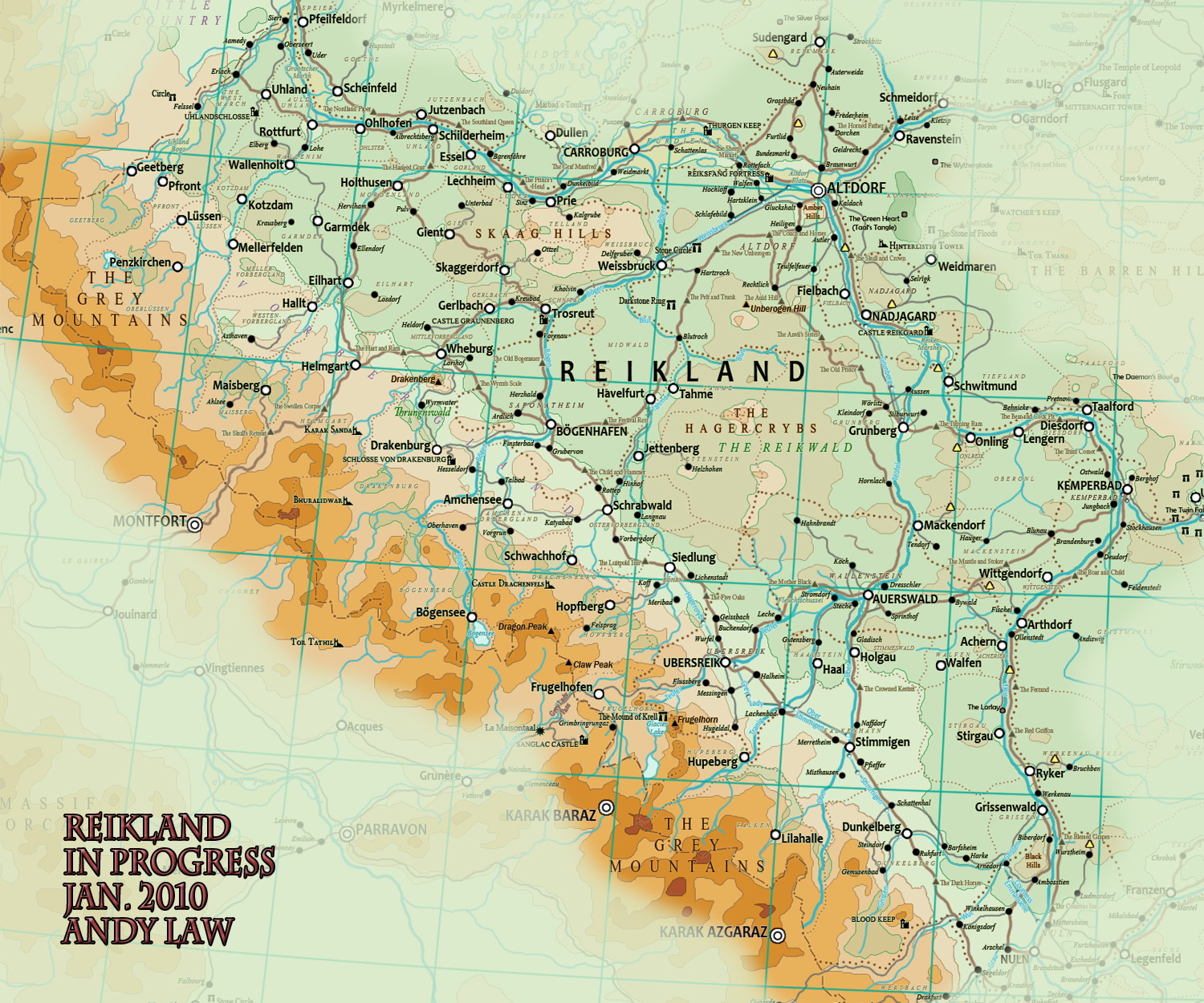
Ages ago I rambled on about older and later incarnations of the Reikland, specifically about how far there are between the "points of light".

At the time my view was that Andy Law's map was probably a more realistic view of the Principality - but less interesting than the Death on the Reik version in terms of adventure. Now I'm not so sure...

I finally sat down to work out some demographics, drawing on figures from Wikipedia, and S. John Ross's Medieval Demographics Made Easy, and here's what I've come up with. There's some pretty extreme hand-waving involved here, so probably any other conclusion is equally if not more valid, but with a couple of tweaks it seems that the Reikland Gazetteer is at least plausable.

In Demographics Made Easy terms Reikland has 2 cities (Altdorf and Nuln), although it shares them both with neighbouring provinces. Despite the Renaissance setting, given how surrounded and riven with enemies (orcs, beastmen, etc.) the Empire is I'll stick with just 9x the number of towns compared to cities, and not the 14x the number. So we have 18 towns.

With the random 10% to 40% drop in size from town to town, here are my 18 towns compared to the Gazetteer -

Generated town Pop Reikland town Pop (adjusted)
Town A 7200 Carroburg 8000
Town B 5040 Bogenhafen 4500
Town C 3024 Kemperbad 3750
Town D 2722 Ubersreik 3500
Town E 2177 Dunkelburg 3000
Town F 1306 Auerswald 2500
Town G 1176 Schoppendorf 2500
Town H 1058 Delberz 2000
Town I 952 Stimmigen 1750
Town J 857 Grissenwald 1500
Town K 686 Grunburg 1200
Town L 411 Rottefach (nr Altdorf) 720 (was 88)
Town M 370 Autler (nr Altdorf) 648 (was 81)
Town N 296 Segeldorf (nr Nuln) 518 (was 48)
Town O 237 Geldrecht (nr Altdorf) 414 (was 49)
Town P 213 Koch (nr Auerswald) 373 (was 95)
Town Q 128 Wurstheim (nr Nuln) 223 (was 78)
Town R 102 Kleindorf (nr Grunburg) 179 (was 35)

Of course this is very arbitrary, but the exercise did highlight what seemed odd about the Gazetteer listing, being the complete lack of any settlement in the 101 to 999 population range. So selecting some villages at random (but concentrating near Altdorf and Nuln for obvious reasons) I've upgraded a few to towns.

Equally there's no reason why lots of more villages can't exist, but since the Gazetteer goes down to such small populations I'm happy assuming it lists them all. And a small number suits nicely the zone model described in the world guide section of the rulebook.

All of which is a very roundabout waying of saying I can justify to myself using the Death on the Reik version.

I'll check through the major coaching routes and make sure there's at least a coaching inn (perhaps heavily fortified) for each reasonable days travel. But prepare yourself for a much lonelier journey than would be the case with the later map.

Or at least, you hope you're alone...

One other thing

The reason I mentioned the Wikipedia demographics - the top 3 cities in the Holy Roman Empire in 1500 accounted for around 1% of the empire's population. So taking Altdorf, Nuln and Middenheim (total population 40,224) and allowing a much higher (3%) proportion of the population - allowing for how dangerous the rural areas are - that gives us a very rough population for the Old World Empire of around 1.3 million.

The Old World is a lot less densely populated than early 16th Century Europe.

Sunday, 5 October 2014

Still searching for new old hobgoblins

I've been dithering excessively over my new hobgoblins - 7 months and counting  :(  - after having second thoughts over a few of them, and hence broadening my search for other options.

A big part of the problem is that I have two Fantasy Tribe and two C36 hobgoblins that I want to include in the mix, and singles or pairs from four other ranges, while hopefully ending up with a fairly coherent (but not uniform) unit.

In parallel to that, it's quite hard to say what defines a Citadel hobgoblin. The Fantasy Tribe figures are very much in fantasy armour - it's hard to identify any real world parallels. In fact the closest I can come for a match is imperial Roman armour, with distinctly non-Roman helms. See for example this Roman general -

Warlord Games' Roman general - image from Bob's Miniature Wargaming Blog
- whose armour bears a passing resemblance to the Fantasy Tribe chieftain seen here on the right, or so I feel -

Eastern hobgoblin from Mirliton, Armalion Red Moon orc, FT hobgoblin
The later C36 hobgoblins and especially the DL2 Hobgoblin Warriors move to somewhat more of an eastern vibe, but rather than full on samurai armour the C36 miniatures are more like full mail with patches of samurai armour, and the DL2s have samurai armour over flesh, whereas most samurai miniatures seem to be armour over clothing (sort of like the eastern hobgoblin in the picture above, although it's hard to tell much with the undercoating, sorry...).

Nihon orc, Grenadier goblin, FT again for size

The Mirliton Nihon orc shown above seems to me to fit well with the more eastern of the Citadel miniatures, or the N17 Chronicle hobgoblins, however he is unfortunately the only one of the range I particularly like. The others all seem a bit chunky and crude and, as can be seen by the amount of crouching in the picture above, they're also a fair bit bigger than the other hobgoblins I've assembled. The goblin on the other hand is too short, but looks so great I had to include him!

I next looked to the Wargames Factory orc warband, which I rather like, however as shown below they're a bit on the skinny / realistic proportion side, in comparison to these other figures -

Wargames Factory warband orc, FT for comparison
They do however have a good-enough match for the Fantasy Tribes armour, I feel. I'm thinking of heroic-ing them by chopping the body in half vertically and puttying it back together with broader shoulders, and then adding bigger heads - perhaps the Hasslefree goblin ones. Rather more work than I was planning on originally!

I've one further plan up my sleeve - the ronin from Black Hat's samurai range seem a good source for samurai armour over flesh, so again I'm thinking of giving these some head swaps.

I do realise this is all slightly silly - given the amout of work involved I'd be much better off just holding my nose and paying over the odds on Ebay for actual Citadel hobgoblins, but this way is so much more interesting!