Showing posts with label WFRP. Show all posts

Wednesday, 14 June 2017

Gruesome goblin-ing

On Saturday Nick and I headed over to Paul D's place for some long-overdue Oldhammer. Paul had set up a scenario and I was to field a goblin-only force for the first time. It's something I've been interested in trying ever since I got back into the hobby - I was wary of their general cowardice but intrigued by the possibilities of the ultimate horde warband.

Goblins are way down my painting list at the moment though, so it was great to be able to make use of Paul's extensive collection for the experiment. Much easier than painting the 103 figures needed for my 750 point force!

I'd like to write up a proper report but given that I still have to do the write-up of our Kremlo games from a couple of months ago I'm kind of hoping someone else will beat me to it... Meanwhile I thought I'd give some first impressions.

Underlying it all is the issue that I'm clearly not good at this generalship lark - Paul had lots of advice (or perhaps more accurately classed as astonished questions) at the end of the game which, if the ideas had occurred to me at the time, might have made things less heavy going. One was distinctly situational but others were more routine and in at least one case I should have known the better course of action. More games and hence more practice are probably a big part of the answer, but one of my weaknesses seems to be that I'm not good at seeing some of the tactical possibilities of the terrain.

Other challenges had more to do with goblins, specifically their appalling personal stats, and my warband selection. My deployment, and not remembering to keep my general central, were also slightly self-inflicted hurdles.
  • On the selection front I really don't like warbands where the troops are just cheerleaders for the heroes, but I went a bit too far down the opposite path having only two heroes and two low-level wizards (albeit that my general was level 20 - and still extremely cheap being a goblin). In future I'll go for at least two decent level heroes (15+, so as to get a Cool bonus as well as Leadership).
  • Even with heroes it's a given that goblins are going to fail most Leadership, panic and rout tests. That being the case the key is to minimise any such tests. So for example, if being charged, running away is not really an option - it will likely turn into a rout, and other nearby units will follow suit. Far better to hope for the best in combat (and trust to deep formations).
  • Deployment and maneuvering are also key - flanks need to be kept protected. That unit at the bottom middle in the photo above is outside of the wall so that they can safely deliver their cargo of fanatics - but having them exposed like that turned out to be bad...
  • Generals don't belong in flanking forces or off chasing objectives - best to keep them central where their Leadership bonus can be used as widely as possible. This is the one that annoys me most, as I remember it being a mistake I've made before!
It'll be some years probably before I get to give goblins another proper go, and I'm kind of looking forward to the challenge. Meanwhile I'll go back to painting my chaos warband, and revelling in their stats...

Tuesday, 28 February 2017

The ox with a rocks in a box - some GMing lessons learnt

On Friday we had another Oldhammer get-together which I was privileged to GM. Rather than do a report I wanted to make a note of the lessons I learnt in the process but fear not, there's a report from the half-orc point of view on the Oldhammer forum.

My main conclusions are perhaps obvious in hindsight -
  1. The players only know what's in their briefing, and have fairly blunt tools with which to learn more
  2. They also don't know what not to worry about
  3. The players will do the completely unexpected
  4. Prepare for what-ifs (as far as you can)
  5. Preview (and if necessary mildly tweak) player-selected forces

My starting point was that I had three forces to cater for: some half-orc mercenaries (who were more interested in the looting than the fighting side of their profession), undead and beastmen. We were aiming for 750 points each roughly from the 3rd edition Warhammer Armies allies or mercenaries lists, although these were more of a starting point than a hard and fast rule.

Three-way conflicts are tricky to set up, with the main solutions being that everyone wants the same thing (the Vengeance of the Lichemaster approach) or a triangular affair. The latter seems slightly less forced to me - although it's very handy that everyone turns up to sort out their differences at just the same time! I feel though that I came up with a good-enough justification for this...

So my basic premise was this:
  • The half-orcs have been hired to guard a sorceror who's on his way to a tor where magic is particularly strong, carrying some heavy artefact (with the help of an ox)
  • The beastmen want to kill the sorceror
  • The necromancer is near the tor for his own reasons, and decides to get involved
And on a slightly more detailed level:
  • The half-orcs' primary objective is to survive, ideally getting some loot in the process and without completely destroying whatever reputation their mercenary company has. They know that the sorceror they're guarding seems weakened (but in hindsight should have known more)
  • The necromancer knows that magic is strong near the tor and also that there's some sort of spirit tied to the tor. He believes that enough bloodshed near the tor will enable him to release or summon the spirit
Or at least that's what I thought would happen...


The initial setup has the sorceror, ox and half-orcs approaching the tor (from the top of the photo) as the undead arrive from their right. The table edge on the right hand side of the shot is marshy and impassable.

Lesson one: the players don't know what the GM knows (which after all, is kind of the point!). But unlike with an RPG, where you get the chance to drop increasingly unsubtle clues, anything which isn't made explicit to the players will probably remain unknown: they're too busy focusing on the tactical situation as they see it, and a wargame doesn't really provide the tools for investigation. "Me and my warband are going to go and talk to that other warband" doesn't often happen (although perversely it did in this battle!).

Lesson two: players don't know what not to worry about (also pointless GM backstories are largely pointless).

I have a mild loathing of GM PCs, in RPGs and wargames. They're especially troublesome in the latter where they call into serious question the GM's impartiality. Nevertheless I'd included Peelbone the sorceror in the scenario and was running him myself, as having the half-orcs control him would have unbalanced things too much. He was a powerful-ish sorceror (in order to give him enough wounds to keep things interesting), but with a fairly weak and situational selection of spells. In addition he starts the game with only 6 magic points.

To go more into the backstory (as it's the only chance I get!) also unbeknownst to the players Peelbone doesn't really know what the McGuffin is or what it does, having acquired it from his former mentor as the latter slipped into insanity (being betrayed and murdered by your protégé practically counts as natural causes amongst chaos sorcerors, surely?). He believes that if he energises it near the tor (via the demonology Summon Energy spell) it will summon a powerful demon which he'll be able to control.

The first turn saw Peelbone's familiar (who's reduced to ox-handling duty) take the ox towards the tor and unload its burden, with Peelbone seeming unfazed by the approach of the undead. The undead shamble forward at which point the beastmen arrive -


Peelbone is somewhat more concerned about the beastmen (I'm assuming he recognises them and knows they're out to kill him - he must have good eyesight!), and orders the half-orcs to deal with them. At this point I'm starting to refer to Peelbone and the half-orcs as "us", which causes the odd raised eyebrow from the other players. I know I can trust me, but they don't...

On his next turn Peelbone calmly casts Summon Energy, and all the factions see a swirling mist appear which is drawn partly into Peelbone, and partly into the McGuffin. On the one hand hopefully this worries them slightly, but on the other hand it probably also has them muttering to themselves about GM PCs... The undead and beastmen continue to advance, with the half-orcs turning to deal with the beastmen.

Lesson three: no scenario survives contact with the players. Given the half-orc backstory and the stacked odds against them, at this point they were meant to start worrying primarily about their own skin. But instead they got all professional...! Also the necromancer wants stuff to die near the tor so should have been backing off and letting the beastmen approach, but fascinated by the two-headed ox he was instead determined to take possession of the bundle it was carrying and so raced forward (or at least as fast as his force could shamble).

Peelbone now works out that the McGuffin doesn't do what he thinks, or at least something has gone wrong, so starts trying to save his own skin while keeping possession of the ox and the McGuffin (which his familiar now loads back onto the ox). He casts Cause Panic on the centaurs (as the fastest and hence most immediate threat) - they fail their willpower test but pass the panic test with flying colours.

Lesson four: think through what might happen. The necromancer, moving rapidly forward, casts Fire Ball at Peelbone. And is close enough to the tor for it to be twice as powerful as normal - Peelbone is toast. I was quite glad to see this on the one hand any concerns about GM PCs evaporate, but on the other hand it's part way through turn 3 and the beastmen's objective has gone up in smoke...


Fortunately the beastman general decides there's killing to be done so carries on regardless and from here we got into a fun little game. The necromancer was determined to take possession of the McGuffin (and is delighted to find out that it's a rock in a box carried by an ox, but somewhat unsure what to do with a large, heavy, rune-inscribed rock), while the half-orcs try a mixture of delaying, fighting and negotiating with the beastmen, hoping for reinforcements to help avenge their former employer.

I had plenty to do as a GM as in this sort of open game situations crop up which aren't covered by the rules, or which the rules don't allow but which seem reasonable under some circumstances. For example the half-orcs beat back a charge from the beastmen and then wanted to push them back without following up - for a second chance at negotiation, hopefully this time with a bit of stick to go with the carrot. By the book this isn't an option, but I allowed it on condition of a leadership check (to keep the victorious side in check).

Lesson five: balance player's freedom to chose their force with a bit of oversight (and know in advance what they're going to bring). This didn't have any real impact on the game but I now remember this tripping me up once in the past, and it also left a couple of oddities this time around. The first oddity was that the half-orcs had a shaman, and so should have known a bit about the McGuffin and one of its effects, but I didn't know this in advance and wasn't prepared for it. The second oddity was that the beastman leader had the attributes of Cowardice (fear) and Manic Fighter (hatred) - it made for some fun situations in the game, but probably isn't a sensible combination for the leader to have. In future I think I'll generate attributes ahead of the game.

My other, slightly depressing conclusion is that as well as all of the forces I need to be painting (chaos, orcs, vikings, dwarves) I also need a few oddities and objective markers to add flavour to scenarios. My two-headed ox from BOYL '15 added immeasurably to this game, and there were several other bits and bobs I could have done with for this time around, or will need if we take this story forward. There's never enough painting time...

Saturday, 18 February 2017

Thinking about Warhammers while reading Wolf Hall

I recently read Wolf Hall, partly because it's well regarded and I needed something to read but mostly because it's mainly set from 1520 to 1535, or about the time that a bunch of ne'er-do-wells are getting caught up in goings-on at the Schaffenfest in Bögenhafen. It seems well-researched but, even if not, it's plausible enough to be taken at face value, especially as my primary interest is for insights for an RPG set in a fictional, historical-ish world.

I'm not sure what themes Mantel was hoping to bring to the fore when she was writing the novel but to me a number stand out -
  • The functioning of power
  • The role of religion (clearly a major theme of the book, and of the time)
  • Status, class and wealth
  • The emergence of modernity
  • The medieval family 


 The functioning of power


This is central to the book, given the viewpoint is that of Thomas Cromwell who rises to become Henry VIII's chief minister. But the key point is that all power comes either from the King, or the Pope (although some claim to be servants of God) with nothing by way of checks or balances other than "what will other kings think" (e.g. if you de-throne their niece) or "what does God think". Being human that source of power is rather arbitrary, especially when (depending on how charitably you look at things) they're a man in their late 30s / early 40s with a roving eye or a king with no heir whose father siezed the crown on the battlefield (or both!).

First Cardinal Wolsey and then Thomas Cromwell gain tremendous power and wealth by gaining the ear of a king who's prepared to delegate, but having gained that ear he still needs to be treated with kid gloves. Both are clearly very able men, one being the son of a butcher who's risen to become the preeminent churchman in the realm, the other the son of a blacksmith who's become a successful lawyer and investor. Being close to even a fickle source of power they almost can't help but enormously enrich themselves, with all sorts of people just wanting to shower them with gifts for some reason, while the king is also awarding them propery, incomes and titles.

I'm not quite sure how to take stock of this in game terms, and am not at all comfortable with the idea of a game with the players functioning at these sorts of levels. Nightmare GM pretty much describes both how the game would need to be played and how it would seem - not a fun prospect.

So I think the take-home needs to be not to even think of the term "power" without the modifier of "fickle".

The role of religion


There are two connected religious developments which are highly significant for Cromwell and his peers - firstly Henry's desire to break from Rome and hence grant his own divorce (and handily also get hold of those taxes which would otherwise go to the Pope) and also the stirrings of Protestant reform and in particular the forbidden tome that was Tyndale's Bible.

There are two aspects to this which I struck me as eminently gameable -
  1. The absolute belief in God
  2. Heresy
On the first point you have a king who's trying to divorce his queen, and nobles who are trying to dispose of a cardinal who's displaced and undermined them, and in both cases one of their major concerns is "what will God think?".

From a secular modern perspective this absolute belief has always been the hardest part of a game for me to "get", and in most game settings it's even more important than it was historically given that, in the words of the great Terry Pratchett, the gods have "a habit of going round to atheists' houses and smashing their windows". Why do players very rarely seem to give as much weight to the gods as their historical or fictional counterparts would?

This leaves me wondering whether some sort of mechanical impact of divine disfavour is needed, not just for cleric types but for anyone. Perhaps (for minor disfavour) once per day a successful roll is converted to a fumble (the player gets to chose which roll). For severe disfavour, who knows?

On the heresy front it seems to me that the Warhammer world is missing several tricks. After all, what could be more WFRP than this Wolf Hall quote - "They have their old bones, their glass saints in windows, their candles and shrines, but God has given us the printing press"? In Warhammer of course you have witch hunters and rumours of forbidden gods, and more openly the rivalry between Ulric and Sigmar, or the displacement of the Old Faith by newer gods. But what's entirely lacking (as far as I've seen) are struggles within the following of a particular god, which is both far more interesting than the chaos / not chaos choice but probably also rather vicious.

The two heresies we see in Wolf Hall are Lollardy and Tyndale's Bible - heretical primarily because they undermined the authority of the Catholic church but also in the case of Lollardy being seen as a threat to the establishment more generally. Given how close it is to the establishment in The Empire I think some heretical beliefs about Sigmar are called for...

Status, class and wealth


Part of what makes the Renaissance interesting as a setting is the emergence of the merchant class and how this plays upon the gulf between the nobility and the commoner. But the gulf is still very much there.

Henry VIII is notable for advancing people based on merit, but both Cromwell and Wolsey are commoners in a courtiers' world. Cromwell and his merchant friends are in many cases significantly more wealthy than the nobles they interact with, with at least one noble being heavily in debt to them. But the nobility have status and, equally importantly, heritage. The word of the son of a blacksmith is worth very little, but even physical evidence doesn't stand up particularly well to the friendships that the nobles have nurtured from a young age, or the fact that their grandfathers fought together on some battlefield long ago.

Couple this with the gentry being concious of their relative loss of status and these elevated commoners are on oncomfortable ground.

The emergence of modernity


Another aspect which makes the Renaissance a refreshing change from the pseudo-medieval setting of most RPGs is the emergence of recognisably more modern elements of architecture and culture. The elite are now building palaces rather than castles (Mantel suggests that one reason Henry was keen to reduce Wolsey in status is so that he can claim Hampton Court Palace for Anne Boleyn) and gentlemen are laying out impressive gardens and worrying about the cultivation of strawberries. As a GM you can mix in a dash of costume drama into the grim dark.

The medieval family


The family though is still thoroughly medieval - there's a high mortality rate and a lot of interdependence. Cromwell's wife and daughters die of sweating sickness when he's in his mid-forties, while his nephew Richard Williams adopts the Cromwell surname and prospers as much as Cromwell's own son thanks to Cromwell's favour from the king.

Cromwell also gains a wide variety of hangers-on, running a large household and having minor gentry "apprentice" their sons to him in the hope of them learning his knack for making incredible amounts of money, while Mantel also speculates at various wardships. Certainly his household is exceptional in some ways, considering both his humble beginnings and the high status to which he arises, but the complex, fascinating and slightly melancholy picture which emerges is hopefully one that will stay with me and enhance my game worlds.

And finally...


Most of the way through the book WFRP was at the front of my mind but it belatedly occured to me that it was also saying something about Warhammer 40K, and probably other sci-fi settings as well. In a dystopian future the messages about the fickleness of how power is gained and exercised, as well as in the importance of status and how it influences or limits people's rise and hastens their fall are well worth bearing in mind.

Sunday, 19 June 2016

Game-related historical snippets

I'm reading a lot of history resources at the moment (slowly, as I need to keep a notebook on hand) and in my typical fashion this is a bit all over the place although mainly focussed on the dark ages early medieval period.

I've also at the strength of this intro at Ex Urbe started watching Borgia: Faith and Fear. That intro is fascinating in its own right (a couple of highlights: pink was for poor people, Vikings loved clown trousers), if anything after that the TV series itself is a bit of a disappointment although still worth watching. The main problem with the series is that the writing seems really clunky - characters spend an awful lot of time describing recent events to one another - but when I can overlook that it's very worthwhile for the scenery and mood.

The scenery because it's a good reminder how much more modern the Renaissance was, and hence WFRP is, than the vanilla pseudo-medieval RPG setting. Think palaces not castles - on which note, having also just watched Sam Willis' The Silk Road series, it's worth adding that the Doge's Palace in Venice is also in-period as far as WFRP is concerned.

The mood because it's great to see the cardinals being incredibly corrupt and self-serving while at the same time being devout and god-fearing (this is also a lesson I'm hoping to take on board from the Robert Low I've been reading recently, of having characters be properly influenced by their religious beliefs). Borgia is at times teaching me things I was just as happy not knowing - I'd dimly heard of the Breaking wheel in the past, I now have a much more gut-level appreciation of it thanks to the beginning of the second episode. I don't think there's anything gameable in that, but it always good to be reminded of other sorts of grim for the grim-dark.

On the early medieval side of things I'm struggling slightly to get my bearings. Thanks to Monty Python we know that in many ways the Romans were quite sophisticated, then you had the Dark Ages and then 1066 and all that. The general sweep of the period is quite easy to pick up but the day-to-day, which seems to me essential in a game setting sense, much less so.

A couple of interesting (to me, at least), and related snippets so far concern the development of agriculture. At the start of the period the two-field system was used for agriculture, but was relatively fragile leading to lower surpluses and more frequent famines. The three field system, which apparently was first used in the Loire region in the 8th century, seems to have spread slowly and erratically (both systems were in use in England in the 14th century). But the greater yields from and robustness of the latter not only reduced the likelihood of famine but in addition produced surpluses which in turn made horses more "affordable". Also the horse collar doesn't make its way to Europe until after 900AD so prior to that yoked oxen were the main source of power for ploughing and so on. Over the next few hundred years horses (being more powerful, faster, and having greater endurance) made agriculture still more efficient and made day-to-day existence less precarious.

So, oxen and famines it is!

Monday, 25 April 2016

What does the medieval family look like?


Rick Stump's recent article about village and family demographics, and in particular the graph on there, really got me thinking about what the medieval village and family looked like.

The graph shows population before the first demographic transition which is yet another reason that, despite enjoying medieval game worlds, I really don't want to live there. In simple terms, people are dying as fast as they're being born, mainly from the old standbys - disease, famine, war and famine caused by war.

From the starting points in Rick's article I thought I'd try and visualise what the population of a village really might look like but then, deciding that particular rabbit hole was a bit too deep, thought I'd instead try to get a picture of just one family. I'm sure there's been all sorts of scholarly study on this but only a few interesting data points came to light from my initial hunting. This gives me enough to hang some ideas on to while seeming to me at least to be plausible, however wrong those ideas may in fact be!
  • Högberg et al, Maternal Deaths in Medieval Sweden: An Osteological and Life Table Analysis has all sorts of interesting information, but of most use is the life expectancy graph.
  • There's a widely quoted figure of 14.4 maternal deaths for every 1,000 births in 15th century Florence. This initially seemed a bit low to me given the gap in life expectancy for men and women in Högberg's paper, until you remember Rick's figure of 6 children per family and hence a 9% chance of dying in childbirth for the average mother...
  • The life of Lucrezia Borgia is interesting anyway, but especially so in this context, giving the stark reminder that a limiting factor in the size of a family wasn't the parents deciding not to have more children, but one of the parents dying! Again from the Högberg's paper it can be seen that the average life expectancy for a woman was around 33, for a man around 40 (although interestingly if they can reach age 50, life expectancy is actually slightly higher for women - presumably due to the risk from childbirth being removed).
From there I had enough (probably dodgy) data points to get started from -
  1. Given that 33 year life expectancy and an average family size of 6 children, in hand-waving terms I called that a 1/3 chance of a child being born per year from when the mother is age 16 until age 40
  2. Rick furnished figures for death in infancy and up to mid-teens
  3. The Högberg's paper allows me to generate life expectancy for those who make it to the advanced age of 15!
With some random number generation and the WFRP name generator I came up with the following for a family on a farm somewhere in Reikland in 2504 -

Klemens runs a farm where his recently deceased wife's grandfather still lives, her father having died just a few years before. They have four surviving young children (although the random number generator says Gustaf will be dead within the year). Brother-in-law Friebald and his wife Esmeralda are an invaluable help as is his sister-in-law Carlotta, although she'll probably be married off soon. Rigo (aged 13) and Eldred (aged 11) are both expected to do a full adult's share of the work as well.

I found generating the above an oddly poignant process, as the random number generator killed off children that various stages of infancy, or mothers with families, and that was just for entries on a page with labels like "Son A3-2"! But it did bring home those bare statistics about mortality rates in a way that will hopefully give my in-game villages a bit more soul in the future. 

There's are a few things I might give some more thought to when I get the chance, such as making couples more varied in age, especially if I ever tackle the "village" problem - the (fairly obvious) thought being that the smaller the community the more it comes to who's available, or simply not related to the suitor, rather than any thoughts of romance. Passing adventurers who show any sign of success and who have all of their limbs and some of their teeth suddenly move from "we don't like their sort" to "eligible"...!

The other thing to think about is to have the deaths cluster more - although certainly people would die from isolated incidents and accidents, such as the "minor wound becomes infected" theme that I've started to notice from certain historical and dark fantasy authors, at least some would be clustered from disease, famine or violence. It'd be interesting to know what the balance should be between the isolated and the clustered - maybe 3 of the 4 deaths across 2502 / 3 / 4 could actually have been caused by the same event? 

Meanwhile I go back to being thankful for epidemiology and all the rest of our modern wonders.

Sunday, 12 October 2014

Reikland versus reality - some conclusions

Ages ago I rambled on about older and later incarnations of the Reikland, specifically about how far there are between the "points of light".

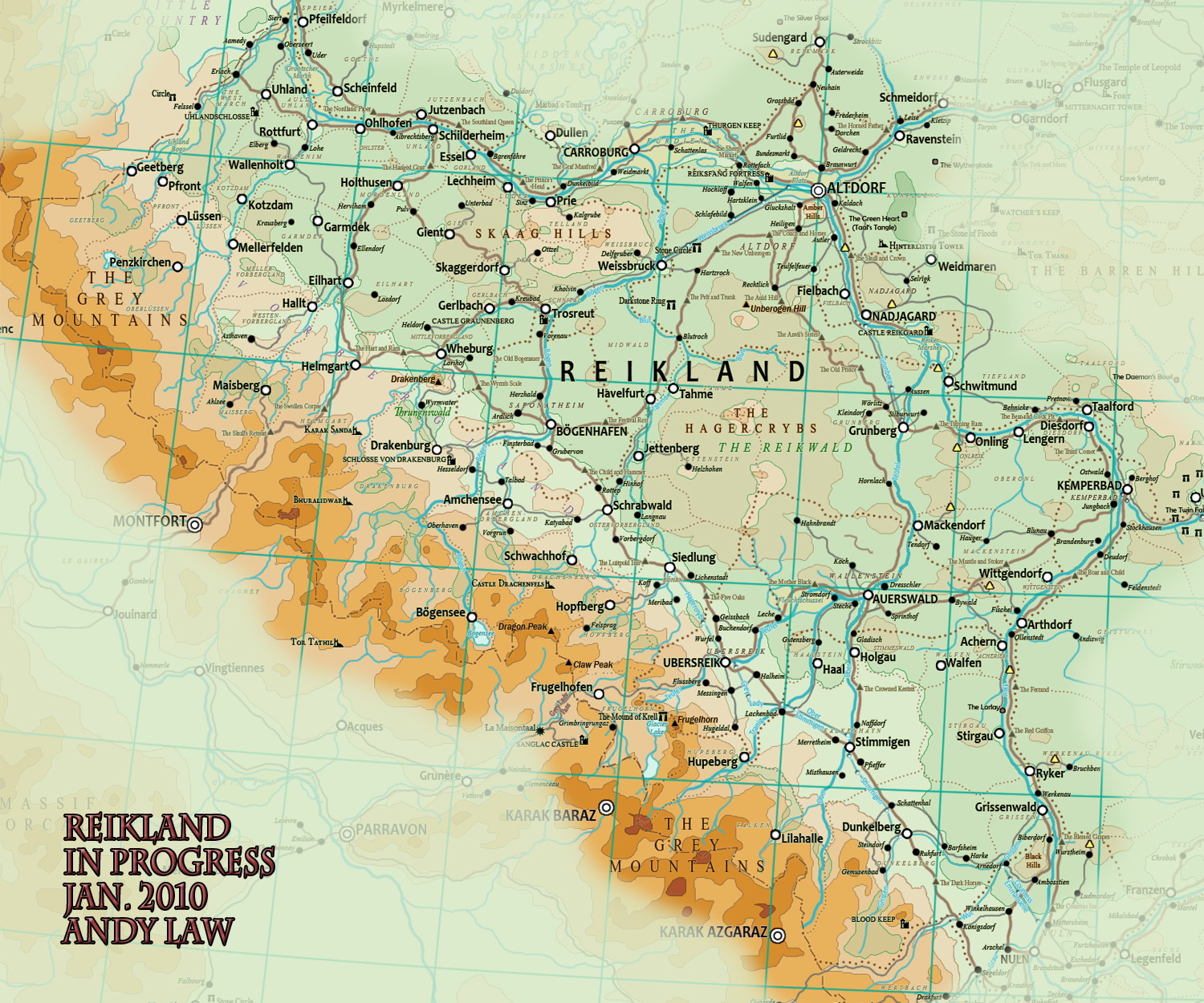
At the time my view was that Andy Law's map was probably a more realistic view of the Principality - but less interesting than the Death on the Reik version in terms of adventure. Now I'm not so sure...

I finally sat down to work out some demographics, drawing on figures from Wikipedia, and S. John Ross's Medieval Demographics Made Easy, and here's what I've come up with. There's some pretty extreme hand-waving involved here, so probably any other conclusion is equally if not more valid, but with a couple of tweaks it seems that the Reikland Gazetteer is at least plausable.

In Demographics Made Easy terms Reikland has 2 cities (Altdorf and Nuln), although it shares them both with neighbouring provinces. Despite the Renaissance setting, given how surrounded and riven with enemies (orcs, beastmen, etc.) the Empire is I'll stick with just 9x the number of towns compared to cities, and not the 14x the number. So we have 18 towns.

With the random 10% to 40% drop in size from town to town, here are my 18 towns compared to the Gazetteer -

Generated town Pop Reikland town Pop (adjusted)
Town A 7200 Carroburg 8000
Town B 5040 Bogenhafen 4500
Town C 3024 Kemperbad 3750
Town D 2722 Ubersreik 3500
Town E 2177 Dunkelburg 3000
Town F 1306 Auerswald 2500
Town G 1176 Schoppendorf 2500
Town H 1058 Delberz 2000
Town I 952 Stimmigen 1750
Town J 857 Grissenwald 1500
Town K 686 Grunburg 1200
Town L 411 Rottefach (nr Altdorf) 720 (was 88)
Town M 370 Autler (nr Altdorf) 648 (was 81)
Town N 296 Segeldorf (nr Nuln) 518 (was 48)
Town O 237 Geldrecht (nr Altdorf) 414 (was 49)
Town P 213 Koch (nr Auerswald) 373 (was 95)
Town Q 128 Wurstheim (nr Nuln) 223 (was 78)
Town R 102 Kleindorf (nr Grunburg) 179 (was 35)

Of course this is very arbitrary, but the exercise did highlight what seemed odd about the Gazetteer listing, being the complete lack of any settlement in the 101 to 999 population range. So selecting some villages at random (but concentrating near Altdorf and Nuln for obvious reasons) I've upgraded a few to towns.

Equally there's no reason why lots of more villages can't exist, but since the Gazetteer goes down to such small populations I'm happy assuming it lists them all. And a small number suits nicely the zone model described in the world guide section of the rulebook.

All of which is a very roundabout waying of saying I can justify to myself using the Death on the Reik version.

I'll check through the major coaching routes and make sure there's at least a coaching inn (perhaps heavily fortified) for each reasonable days travel. But prepare yourself for a much lonelier journey than would be the case with the later map.

Or at least, you hope you're alone...

One other thing

The reason I mentioned the Wikipedia demographics - the top 3 cities in the Holy Roman Empire in 1500 accounted for around 1% of the empire's population. So taking Altdorf, Nuln and Middenheim (total population 40,224) and allowing a much higher (3%) proportion of the population - allowing for how dangerous the rural areas are - that gives us a very rough population for the Old World Empire of around 1.3 million.

The Old World is a lot less densely populated than early 16th Century Europe.

Saturday, 1 February 2014

Reikland versus reality

I managed to pick up a copy of Death on the Reik last week in decent condition for a very reasonable price, but with one downside. As seems to be common, it was missing the A3 Reikland / Castle Wittgenstein map, which is obviously not ideal.

On the plus side it did make me think rather more about how Reikland should look than I otherwise would have (and perhaps more than is healthy!). It also made me more conscious of an insightful post I read on G+ recently about how geek fans (that'll be me) sometimes loose sight of theme because of over-emphasis on facts. You'll see what I mean in a minute...

Back to the maps - there are lots of useful Reikland maps on the internet, and Gitzman's Gallery collects some of the best ones together. There's a wide variation in what they portray, which is fair enough for a pseudo-16th century setting, but the detail which is bothering me is how densely populated they should be.

Exactly where point A is in relation to point B is fairly irrelevant to the characters on the ground, but what is relevant is if you leave (for example) Bögenhafen on the road to Altdorf and travel for most of the day, how many settlements do you pass? As it gets later do you press on in reasonable expectation of getting to the next town or village?

Going by the map in Shadows Over Bögenhafen (Hogshead version) there are 3 coaching inns and a village between Bögenhafen and Heiligen on the outskirts of Altdorf. The detailed map in Gitzman's Gallery (which I believe is by Andy Law, who knows his WFRP) has 4 coaching inns, two villages and a town on the same route.

This may seem like I'm being pedantic, but hopefully that's not it. The Warhammer Old World, and especially the Empire, is fun because its a bit more modern than the usual fantasy setting, and can give rise to themes that wouldn't work in a more traditional medieval setting. To support the scheming nobles and growing merchant class that we all all know and love you need a certain scale and level of advancement to the place. But that same scale and modernity act against the lonely wildness of parts of the Empire, with beastmen (and worse) lurking in every stretch of forest.

Even the more densely populated maps have plenty of wildness for such things to roam, but I think I rather prefer the "points of light" approach of the older maps, where every settlement of any size in Reikland (Harke, population: 25) can be listed on two sides of A4.

Tuesday, 2 July 2013

Anti-heroes for wargames

I imagine a lot of roleplayers have done "playing as the monsters" at some point, even without taking into account things like World of Darkness, factional MMORPGs such as World of Warcraft, or of course fantasy wargames.

In a traditional fantasy setting such as the Old World, dark elves or goblinoids would seem the obvious choice for monster PCs, but the former have a distinct ring of Mary Sue to them, whereas orcs and goblins are too fractious and (dare I say it) unsophisticated to give much depth to the roleplaying or longevity to the campaign.

Chaos cults are another obvious choice within the Old World, and to some degree would suit a WoD "society with society" type campaign, but I'm not sure that offers anything particularly new.

What would interest me would be a "killing things and taking their stuff" campaign playing as Skaven, or un-reconstructed WoW Forsaken, where characteristics and motivation are sufficiently human while morality and quest objectives are diametrically opposed to the norms of the game. I wonder, having played such a campaign, how players would then approach a traditional D&D scenario once they're back in the shoes of the "good guys".

Thursday, 25 April 2013

RPG combat and realism

Noisms' latest post on creating gritty and realistic tactical combat struck a chord with me for a number of reasons.

I swing between a variety of moods when it comes to RPGs in general, and their combat systems in particular. Sometimes I think that D&D combat works fine on an abstract level, hit points are not meant to represent actual damage, and it's fine that a hero can take on a dragon and win. Usually I need something grittier, and think all PCs should be afraid of dying to mundane threats, and certainly shouldn't be able to shrug off attacks from dozens of lesser foes. And occasionally I think that PCs have it far to easy in even the grittiest system, and anyway we just don't know enough about medieval / renaissance combat (despite the wonders of YouTube!) to create a remotely credible system so why bother!

Most of the time though I'm happy that combat in WFRP1e is "good enough", and appropriately gritty for me. I would like to put that to the test a bit, and for example model some of the following, in order to put some sort of metric on the lethality of the system -
  • Lightly armed militia versus unarmoured labour
  • Unarmoured dualist versus each of the above
  • Fully armoured dwarf judicial champion versus each of the above
Hopefully at the end of things I'll still be happy that it's gritty enough. If not I might have to adopt Noisms' system.

Meanwhile, I need to learn more about the life expectancy of a Roman gladiator.

"Fixing" WFRP 1e - what to house rule?

Thanks to the WFRP A-Z blogging challenge, in particular some great posts from +Marc Torley, I stumbled across the nostalgia fest that is Let's Read: WFRP First Edition and hence Zweihänder's Whiff Factor discussion.

This led me back to a topic that's been on my mind if I ever do ever get back to GMing WFRP, which is what if anything I would house rule?

I don't remember us having house rules back in the day, although I know I overlooked at least two rules as written - the +10 bonus for winning, and critical skill failures (30+ over the target number). I also had a dwarf warrior player in my main group, and while he and the party knew he was very hard to kill it also never led to the mindset where they could just fall back on violence at any opportunity. WFRP players know that the world is against them, even if right now they may be winning...

So, with the benefit of hindsight, what if anything do I feel is wrong with the WFRP 1st edition rules, and is serious enough it needs fixing?

Not broken, in my opinion (but commonly viewed as such)

  1. The imbalance of starting careers (that's life)
  2. The extremely slow progression of spell casters (magic is difficult)
  3. Elves dominating with high Initiative (they're not human)

Broken, but leave as is


Strength / attacks for large creatures. Clearly dragons and giants should be on a whole other strength scale than the characters are, and in the case of giants should probably be slow but hard hitting (miss, dodge, miss, miss, dead character). However I can't see myself using anything larger than a troll in a campaign, so this doesn't bother me enough to house rule

Slightly broken

  1. The "whiff" factor
  2. Naked dwarf syndrome
I don't think the "whiff" factor (i.e. starting characters being a bit rubbish) is nearly as big an issue as the Zweihänder author does (for example). He has valid points - the chance of critical failure versus success is too high for starting characters, and the multi career characters are conversely powerful. There is also the common complaint that in some circumstances (often elves again) an unskilled character with high stats is better than an average character with the appropriate skill. I think my house rule here should be to follow my earlier ignorance, and for first career characters at least to play critical failures for comedy rather than danger value, rather than forgetting about them entirely. Otherwise I feel the rules as written are good enough (though clearly not perfect).

The naked dwarf syndrome I'm also not sure is a huge issue, but they probably are slightly too tough in some circumstances. I'd probably have a rule something like for creatures of above average strength (4+) an above average hit (either 6, or perhaps 4+) does a minimum of 1 wound. So I'm happy to have goblins beat on an armoured dwarf all day, but at some level they do have to worry about attrition from tougher opponents, even without the possibility of an exploding dice.

So that's my starting point, though I do have a big list of discussion threads to review from around the interweb to see if there's anything I've overlooked. Meanwhile, what glaring holes are there in my list?

Saturday, 2 March 2013

Campaigns I'd like to run

I say "like to run" as a I'm quite keen to do the research and prep work. I'd be equally happy to play any of them too.

Middle Earth
I played a fair bit of MERP in my youth, but I'd like to try to re-visit Middle Earth with a more appropriate rule set and my now much greater appreciation for the setting. In what little spare time I have at the moment I'm laying some groundwork for a campaign (although I don't currently have a gaming group!) and as part of this have just re-read the last few chapters of Lord of the Rings on my way to the appendicies. It struck me how morally black and white the book is (although some of the history less so, e.g. relations between the Rohirrim and Dunlendings, where the "good guys" can't really claim any moral high ground) which will be a challenge. I'm used to characters being a lot more ambiguous... I'm getting more and more interested in The One Ring as a system, which amongst other things seems to have some quite flavourful mechanics to address the Shadow that hangs over Middle Earth.

Norse / Celtic / Sidhe
A mashup of Tad Williams' Norns and Hernystiri and C.J. Cherryh's The Dreaming Tree, with a smattering of the Bloody Nine. Castles & Crusades Codex Celtarum is looking quite interesting too.

Original Enemy Within campaign - Warhammer FRP (1st edition)
I've never run the original Enemy Within campaign which is a bit of an oversight, given that when I was actively playing WFRP was my preferred system.

Tekumel
I first heard of Empire of the Petal Throne in my teens, and thought it sounded cool, but never discovered anything about it. Now I know somewhat more I'd be interested in running a campaign to move me a bit away from my northern European default.

Old-school D&D
I originally dropped BECMI D&D for WFRP, through a mix of Games Workshop marketing and loss of faith with D&D and PC power levels in particular. Nowadays I think I'd cap things at level 14, or perhaps even try E6. However it'd be fun to try a stereotypical high fantasy campaign, applying everything I've learned since I last ran D&D.

Tuesday, 4 December 2012

How much should characters be able to cheat death in a (fantasy) game setting?

My train of thought is something like -

Akrasia has some very interesting suggestions on making magic in OSR type games more like the tales that spawned them (old post found via Brendan via Dr Bargle).

In that post, Akrasia casually drops in that he has "removed the spells ‘raise dead’ and ‘reincarnation,’". Which is right and sensible, since it deals with a couple of the biggest potential mood issues of D&D, in my view -
  • At a certain level, death becomes a road-bump rather than an ending
  • Even with Autarch's rather good The Demographics of Heroism, your small duchy / large city still has a high priest(ess) who can 'raise dead', so it's not just your PCs who won't stay dead
Just because it's a good fantasy setting, that doesn't mean it's a good game setting (Lord of the Rings being one of the stand-out examples here). And a key differentiator in my view is whether a fair degree of magical (or at least non-natural) healing is available to the characters.

So, my thought is that Akrasia is right, and those two spells should be removed, unless you're going for properly high-fantasy. But that characters should be given Fate Points a la WFRP, to partially make up for this.

I also really like his view of merging cleric and magic user spell lists, and having there be consequences to 'black' magic - the latter point also being echoed in Brendan's post.

However, I'd do things slightly differently -
  1. Magic users get the merged spell lists, and the consequences of 'black' magic, and the normal magic user armour restrictions. This, as per Akrisia's intent, gives you magicians from the vast range of architypes.
  2. Clerics you keep, and with their armour / weapon options. They also get no consequences of spell casting, as the power comes from their deity - except that over time (levels) they get more and more like the deity they follow. Presumably they're OK with this, but it might seem like a tough bargain when viewed from the outside. Mechanically I'm not sure how you represent this, since the alignment 'penalty' that Brendan alludes to for magic users is irrelevant for clerics, and you want the player to still have control over their character. What you can do mechanically though is, per deity, limit the range of spells from the full list that clerics can cast (although this requires a lot of preparation work on fleshing out the deities and their spell lists). Perhaps starting with few restrictions and low levels and ramping this up at high levels is how this would work